
Inside the Urgent Fight to Rebuild America’s Industrial Base
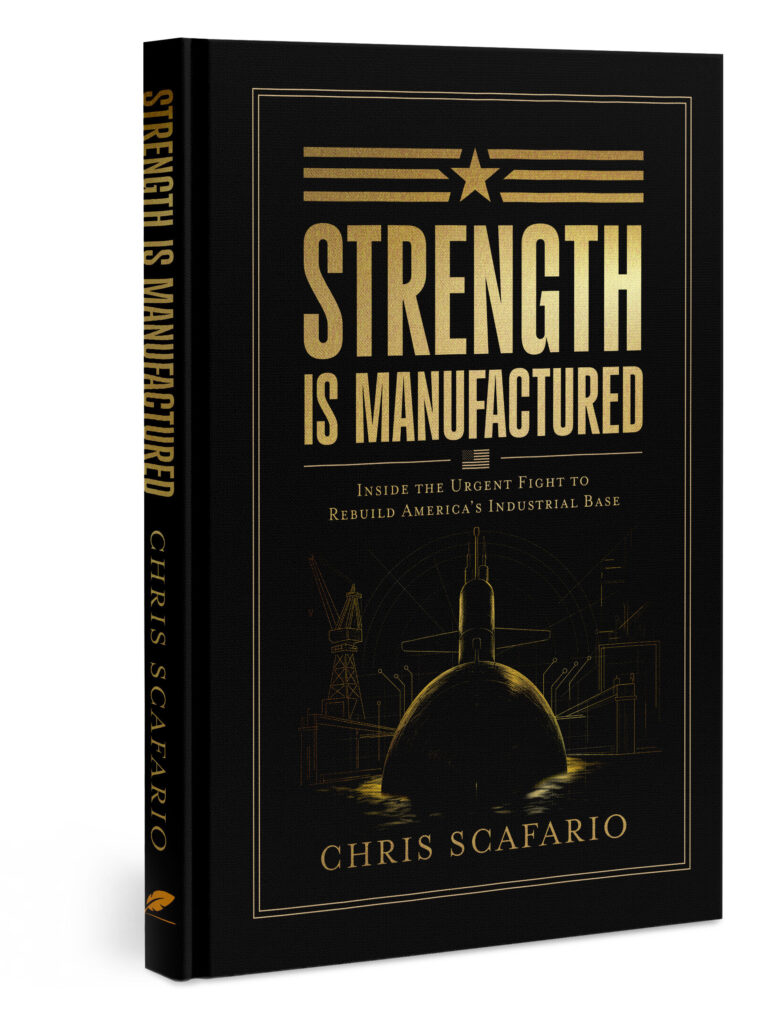
Paperback, Hard Cover and Kindle eBook Versions Available Now. Get the book for as little as $0.00 on Kindle with a subscription.
America never stopped inventing. It stopped making.
The United States still designs the world’s most advanced ships, medicines, chips, and energy systems. What it lost, over four decades of offshoring and neglect, was the productive base beneath the invention: the suppliers, the skilled trades, the tooling, and the capacity to build what we design. A manufacturer can wait four years for a transformer. A machine shop can idle for a season because a single replacement part has to cross an ocean. A country that cannot produce its own medicines, ships, energy equipment, and machine tools is not truly secure, no matter how many patents it holds.
In Strength Is Manufactured, Chris Scafario argues that this is the defining industrial challenge of the decade, and that it will be won or lost region by region, not in Washington. He should know. Scafario is president and CEO of DVIRC, one of the nation’s Manufacturing Extension Partnership centers, and his headquarters sit at the Philadelphia Navy Yard, where a South Korean shipbuilder has committed billions to revive American shipbuilding on a scale the country has not seen in a generation. Few places in America put the stakes of industrial renewal in plainer view.
Drawing on nearly two decades inside plants, boardrooms, technical high schools, and MEP centers, Scafario takes readers from that shipyard to a biomanufacturing corridor, a welding classroom, a space supply chain, and a defense industrial base racing to meet new cybersecurity mandates, and shows what industrial capability looks like when it is rebuilt one firm at a time.
Inside the book:
- The nine industrial sectors that hold the line for national security and prosperity, and what it takes to strengthen each one
- Why the grid, not the factory, may be the first thing that fails, and what manufacturers can do about it
- The workforce question almost everyone gets wrong, and the welding program that answers it
- How a shuttered refinery and a quiet shipyard became a national test case for industrial revival
- The Manufacturing Moonshot: a five-pillar framework for technology adoption, workforce, supply chain resilience, and regional execution that any region can adapt
This is not a nostalgic book about the factory economy of the past. It is a strategic book about the industrial base the future demands: more digital, more precise, more resilient, and more serious about the industries that underwrite sovereignty.
Prosperity is manufactured. Security is manufactured. Resilience is manufactured.
Strength is manufactured.
What’s Inside
Introduction
Strength Is Manufactured: Why prosperity, security, and resilience are all downstream of one thing: the ability to make.
Chapter 1
The Great American Miscalculation: How a nation convinced itself that design and software were enough, and what that bet cost.
Chapter 2
Critical Industries That Hold the Line: The nine sectors that decide whether a country can defend, power, heal, and feed itself.
Chapter 3
Maritime, Shipbuilding, and the Return of Industrial Philadelphia: Inside the multibillion-dollar revival of American shipbuilding at the Philadelphia Navy Yard.
Chapter 4
Power or Decline: Why the grid, not the factory, may be the first thing that fails, and what manufacturers can do about it.
Chapter 5
The Space Industrial Base and the Next Frontier of Making: The supply chain behind the space economy and the small firms being pulled into it.
Chapter 6
Biomanufacturing, Medicines, and the Factories of Human Survival: Cell and gene therapies, biologics, and why the next medical breakthrough is a manufacturing problem.
Chapter 7
The Machines That Make the Future: Machine tools, automation, and AI on the plant floor: the capabilities that decide who builds what.
Chapter 8
Why Regions Will Win or Lose This Fight: The case that industrial renewal is won region by region, not in Washington.
Chapter 9
The Workforce Question We Keep Getting Wrong: The welding classroom that answers the talent problem almost everyone misdiagnoses.
Chapter 10
The Manufacturing Moonshot: A five-pillar framework for technology adoption, workforce, supply chain resilience, and business retention and expansion.
Chapter 11
A New Freedom’s Forge: What a serious national commitment to making looks like, and the role every region can play.

About the Author
Chris Scafario is president and CEO of DVIRC, a nonprofit Manufacturing Extension Partnership center serving small and midsize manufacturers across Southeastern Pennsylvania.
Under his leadership, DVIRC relocated its headquarters to the Philadelphia Navy Yard in 2025, deliberately positioning the organization at the heart of the region’s maritime and defense industrial base. He also launched the AI Center of Excellence for Manufacturers (AiCE) to help companies move from AI awareness to measurable results on the factory floor.
A lifelong advocate for practical industrial renewal, Scafario architected DVIRC’s 2030 Manufacturing Moonshot — a framework focused on technology adoption, supply-chain resilience, workforce modernization, and plant-floor execution. His work has helped place thousands of workers into precision manufacturing roles and has positioned the Delaware Valley as a national model for converting regional industrial DNA into strategic advantage.
Before joining DVIRC in 2007, Scafario grew up in his family’s beverage business and went on to manage multimillion-dollar product lines for global consumer giants including Cadbury Schweppes and Philips. He holds an MBA from Thomas Jefferson University and brings the same commercial discipline and performance mindset he honed in consumer goods to the complex challenges facing today’s manufacturers.